Published in: Marine Drugs
DOI: https://doi.org/10.3390/md23120471
Type 2 diabetes mellitus (T2DM) is a chronic metabolic disorder requiring safer and more effective therapeutic alternatives. This study investigates a novel fucoxanthin derivative isolated from the marine brown alga Chnoospora minima using a comprehensive in silico approach. Molecular docking revealed that the derivative exhibited higher binding affinities toward α-amylase (–9.4 kcal/mol) and α-glucosidase (–8.0 kcal/mol) compared to the reference drug acarbose (–8.5 and –7.4 kcal/mol, respectively). Pharmacokinetic analysis predicted good intestinal absorption and P-gp inhibition (0.894) and moderate plasma clearance (7.864 mL/min/kg), while toxicity predictions classified it in toxicity class 3, with
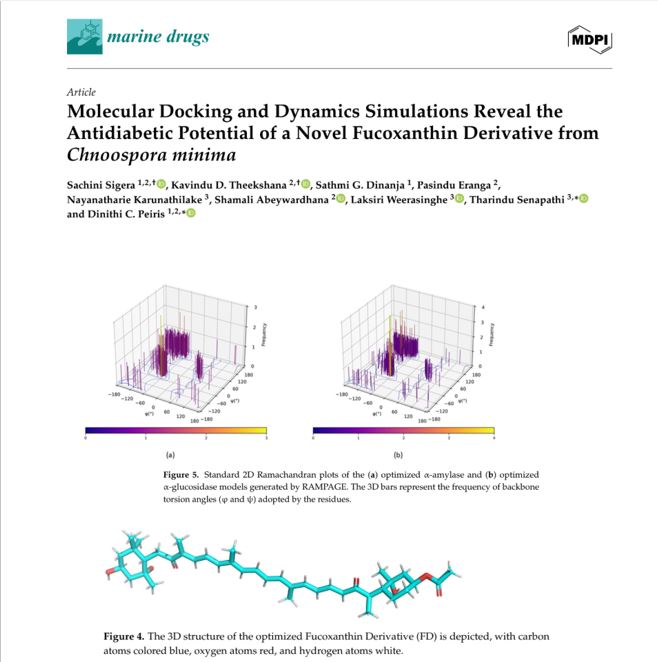
no respiratory or ocular toxicity. Drug-likeness evaluation showed only one Lipinski and one Veber rule violation, common for natural products. Molecular dynamics simulations conducted for 100 ns using NAMD 3.0 confirmed stable protein–ligand complexes with average RMSD values of ~1.3 Å and ~1.8 Å for α-amylase and α-glucosidase, respectively, and consistent hydrogen bonding profiles. Structural analysis identified a substitution of the allene bond with an unsaturated ketone at the C8′ position as a key contributor to enhanced enzyme interaction. The findings suggest that this fucoxanthin derivative is a
promising natural candidate for T2DM therapy and warrants further investigation through lab experiments (in vitro and in vivo).