Pulished in: Aquaculture International
DOI: https://doi.org/10.1007/s10499-025-02362-5
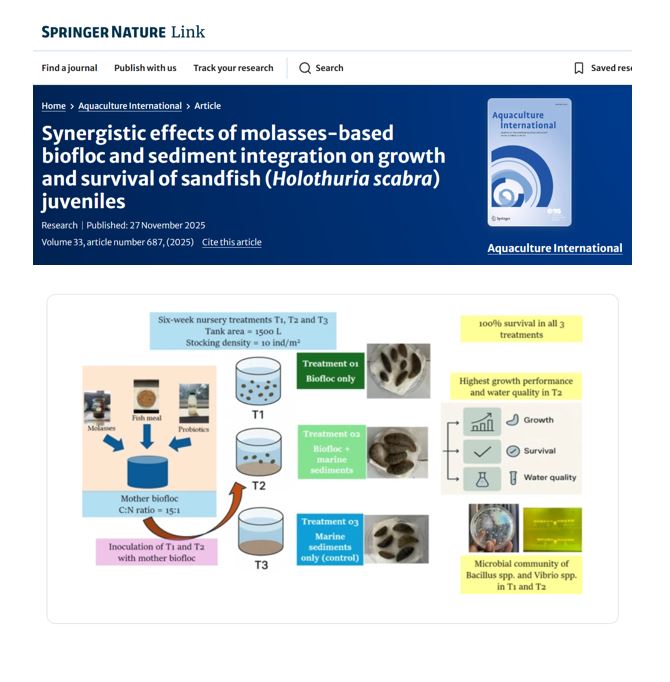
The sandfish Holothuria scabra is one of the most commercially valuable sea cucumber species worldwide due to its high market demand. In Sri Lanka, it supports income generation and the livelihoods of coastal communities; however, the nursery phase is often constrained by suboptimal growth and survival rates. This study evaluated the efficiency of biofloc systems as an improved nursery approach for H. scabra. A 6-week nursery trial was conducted under three treatments: biofloc only (T1), biofloc integrated with marine sediments (sandy-muddy; T2), and marine sediments only (T3; control) with triplicate. Nine fiberglass tanks (1500 L) were stocked with 15 juveniles per tank (mean initial weight 1.48 ± 0.11 g). Fishmeal served as the nitrogen source; molasses was added to maintain a C:N ratio of 15:1. Growth performance, water quality, biofloc volume, and microbial community composition were assessed. Final length, weight, and their gains were significantly (p < 0.05) higher in T2 than in T1 and T3. Specific growth rate (SGR) was significantly (p < 0.05) declined in T1 (0.70 ± 0.55% day−1). Survival was 100% in all treatments. Water quality parameters did not differ (p > 0.05) among the three treatments. Total bacteria density was significantly (p < 0.05) higher in T1 and T2 than in T3. Microbial profiling revealed a higher abundance of Bacillus spp. in T1 and T2, whereas Vibrio spp. dominated in T3. In conclusion, the integration of biofloc–sediment proved to be an economically viable sustainable nursery phase for H. scabra juveniles, ensuring higher growth, no mortality and good microbial profile in zero-water-exchange.