




Pulished in: Aquaculture International
DOI: https://doi.org/10.1007/s10499-025-02362-5
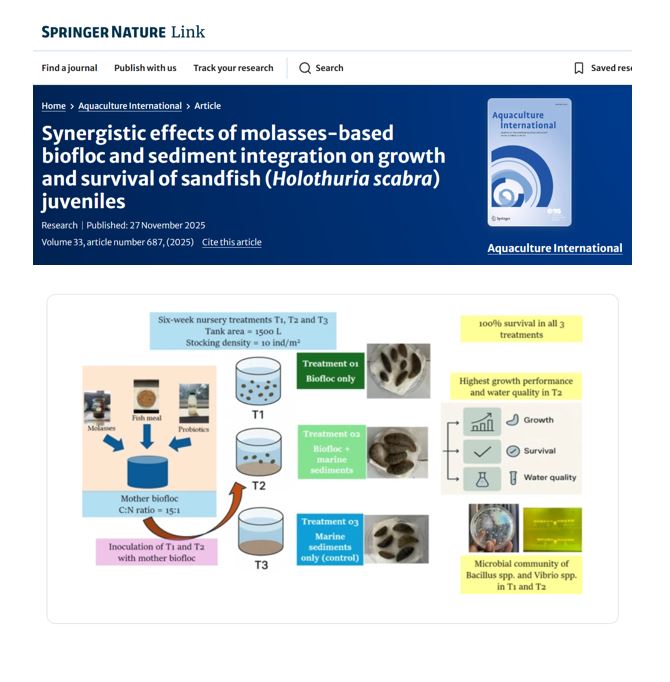
The sandfish Holothuria scabra is one of the most commercially valuable sea cucumber species worldwide due to its high market demand. In Sri Lanka, it supports income generation and the livelihoods of coastal communities; however, the nursery phase is often constrained by suboptimal growth and survival rates. This study evaluated the efficiency of biofloc systems as an improved nursery approach for H. scabra. A 6-week nursery trial was conducted under three treatments: biofloc only (T1), biofloc integrated with marine sediments (sandy-muddy; T2), and marine sediments only (T3; control) with triplicate. Nine fiberglass tanks (1500 L) were stocked with 15 juveniles per tank (mean initial weight 1.48 ± 0.11 g). Fishmeal served as the nitrogen source; molasses was added to maintain a C:N ratio of 15:1. Growth performance, water quality, biofloc volume, and microbial community composition were assessed. Final length, weight, and their gains were significantly (p < 0.05) higher in T2 than in T1 and T3. Specific growth rate (SGR) was significantly (p < 0.05) declined in T1 (0.70 ± 0.55% day−1). Survival was 100% in all treatments. Water quality parameters did not differ (p > 0.05) among the three treatments. Total bacteria density was significantly (p < 0.05) higher in T1 and T2 than in T3. Microbial profiling revealed a higher abundance of Bacillus spp. in T1 and T2, whereas Vibrio spp. dominated in T3. In conclusion, the integration of biofloc–sediment proved to be an economically viable sustainable nursery phase for H. scabra juveniles, ensuring higher growth, no mortality and good microbial profile in zero-water-exchange.
Published in: Chemico-Biological Interactions
DOI: https://doi.org/10.1016/j.cbi.2025.111383
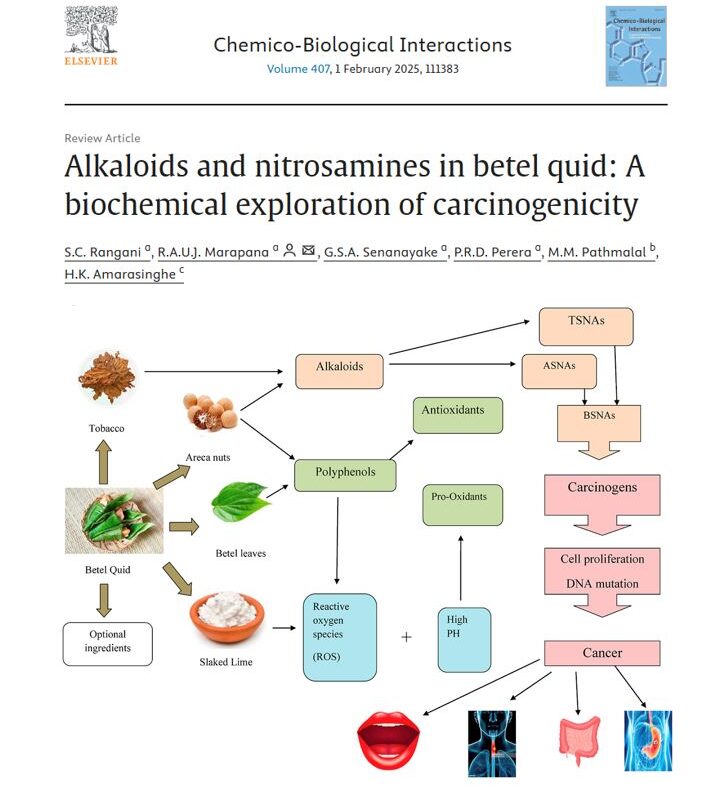
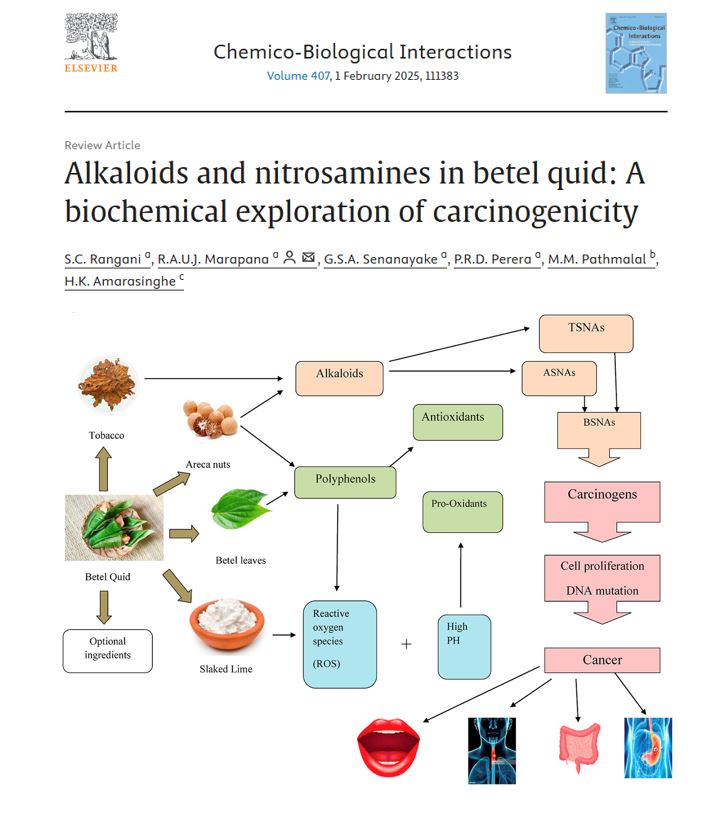
Betel quid contains two major ingredients; Areca catechu and Piper betel, often consumed with slaked lime, tobacco, certain flavouring agents, colouring agents, herbs, and spices according to personal preferences. The areca nut alkaloids (arecoline, arecaidine, guvacine, and guvacoline), and tobacco alkaloids (nicotine, nornicotine) undergo nitrosation during chewing in the oral cavity with the presence of nitrite and thiocyanate and endogenously. Among the nitrosation products generated areca nut-derived nitrosamine (ADNA): 3-(methylnitrosamino) Propionitrile (MNPN) and the two tobacco-specific nitrosamines (TSNAs); N′-nitrosonornicotine (NNN) and 4-(methylnitrosamino)-1-(3-pyridyl)-1-butanone) (NNK) are considered Group 1 human carcinogens. The slaked lime increases pH, reactive oxygen species (ROS) generation, and inflammation further lead to oral potentially malignant disorders (OPMD). The juice swallowed results in carcinogenicity, mutagenicity, and toxicity in the gastrointestinal tract including hepatocytic carcinoma, stomach, and colon cancer. Areca nut pre-treatments (sun drying, roasting, boiling, and fermentation) increase the quid metabolism, and reduce the arecoline content and associated risks. We review biochemical carcinogenesis of betel quid ingredients and synergic adverse effects and possible mechanism of carcinogenesis of betel quid in the oral cavity and gastrointestinal tract to understand the implication of polyphenols and alkaloids of areca nut and betel quid on carcinogenic nitrosamine formation under oral, gastric, and intestinal conditions.
Published in: Marine Drugs
DOI: https://doi.org/10.3390/md23120471
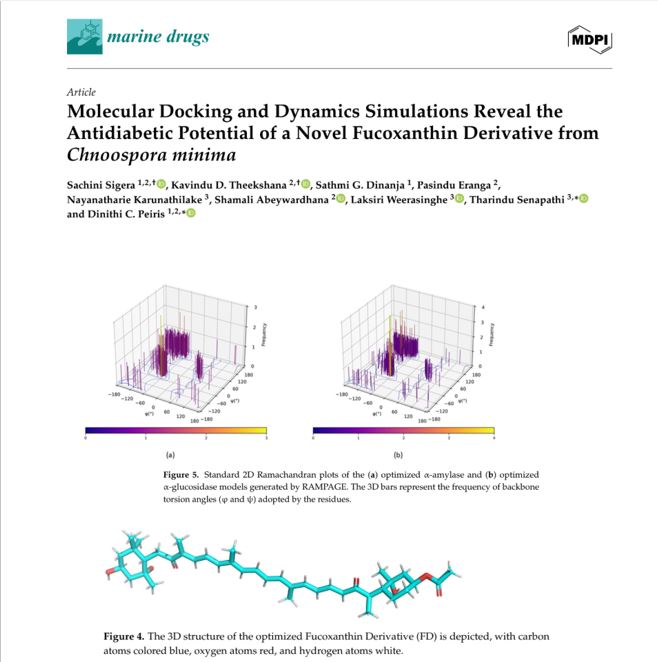
Type 2 diabetes mellitus (T2DM) is a chronic metabolic disorder requiring safer and more effective therapeutic alternatives. This study investigates a novel fucoxanthin derivative isolated from the marine brown alga Chnoospora minima using a comprehensive in silico approach. Molecular docking revealed that the derivative exhibited higher binding affinities toward α-amylase (–9.4 kcal/mol) and α-glucosidase (–8.0 kcal/mol) compared to the reference drug acarbose (–8.5 and –7.4 kcal/mol, respectively). Pharmacokinetic analysis predicted good intestinal absorption and P-gp inhibition (0.894) and moderate plasma clearance (7.864 mL/min/kg), while toxicity predictions classified it in toxicity class 3, with
no respiratory or ocular toxicity. Drug-likeness evaluation showed only one Lipinski and one Veber rule violation, common for natural products. Molecular dynamics simulations conducted for 100 ns using NAMD 3.0 confirmed stable protein–ligand complexes with average RMSD values of ~1.3 Å and ~1.8 Å for α-amylase and α-glucosidase, respectively, and consistent hydrogen bonding profiles. Structural analysis identified a substitution of the allene bond with an unsaturated ketone at the C8′ position as a key contributor to enhanced enzyme interaction. The findings suggest that this fucoxanthin derivative is a
promising natural candidate for T2DM therapy and warrants further investigation through lab experiments (in vitro and in vivo).