Published in: PLoS One
DOI: https://doi.org/10.1371/journal.pone.0337428
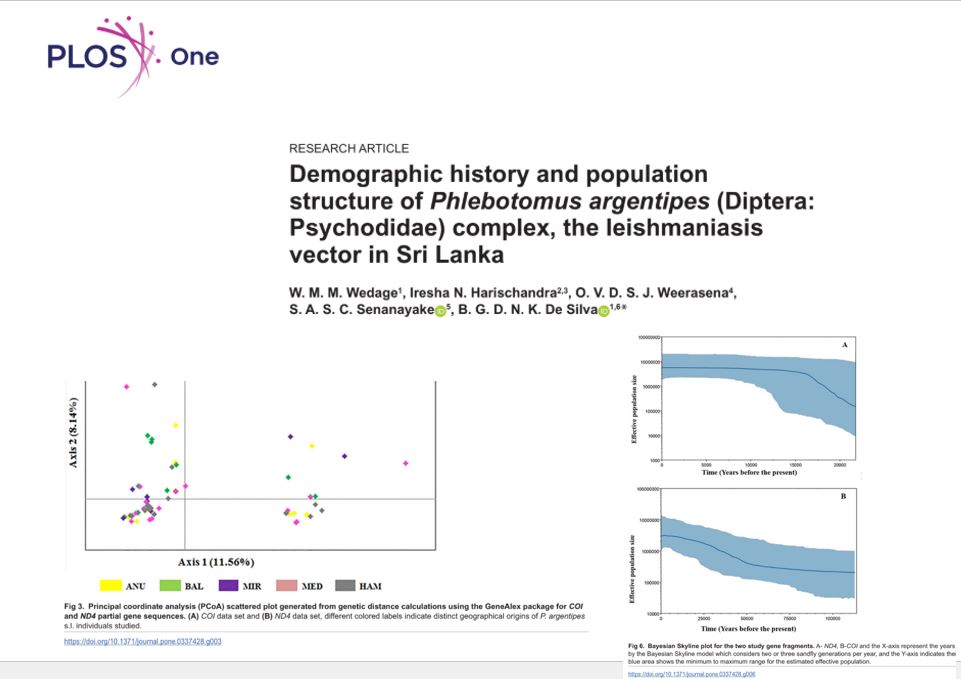
Phlebotomus argentipes sensu lato Annandale & Brunetti, 1908 is the primary vector of Leishmania donovani MON 37, the causative agent of cutaneous leishmaniasis (CL) in Sri Lanka. Effective vector control is essential for managing leishmaniasis. Although numerous taxonomic studies have been conducted on P. argentipes s.l., population genetics remains insufficiently explored. This study investigated the demographic history and population genetic structure of P. argentipes s.l. in Sri Lanka using sequence data obtained from the earlier investigation of two mitochondrial markers, Cytochrome c oxidase subunit I (COI) and NADH dehydrogenase subunit 4 (ND4). For the genetic analysis, 159 individuals from five leishmaniasis endemic sites were examined. In addition to the individual analyses of COI and ND4 genes, a concatenated dataset combining both mitochondrial fragments was constructed to evaluate overall genetic structure and demographic history. The population structure and demographic history of P. argentipes s.l. were assessed using FST estimates, AMOVA, structure analysis, Mantel test, PCoA, Bayesian inference and coalescent analysis. The highest FST value was 0.0271, indicating low genetic differentiation, with over 98% variation occurring within populations. Mantel tests showed weak, non-significant correlations between genetic and geographic distance, indicating no evidence of isolation by distance, suggesting potential gene flow and no distinct clustering within the Sri Lankan P. argentipes s.l. population. Negative and significant neutrality statistics, together with unimodal mismatch distributions, support historical population expansion, further corroborated by Bayesian skyline plots indicating two distinct demographic events, an ancient expansion around 50,000 years ago (COI) and a more recent one approximately 10,000–13,000 years ago (ND4). Additionally, the mismatch distribution analyses revealed a multimodal expansion pattern at the Medirigiriya and Hambantota sites, which are hot spots for leishmaniasis in Sri Lanka. The present study demonstrates a demographic expansion and genetic homogeneity of P. argentipes s.l. populations in Sri Lanka, supporting the species’ ability to colonize new areas and possibly enhance leishmaniasis transmission. This connectivity may facilitate the spread of adaptive traits such as insecticide resistance, even in the absence of local selection pressure, posing a potential challenge for future vector control efforts in Sri Lanka.