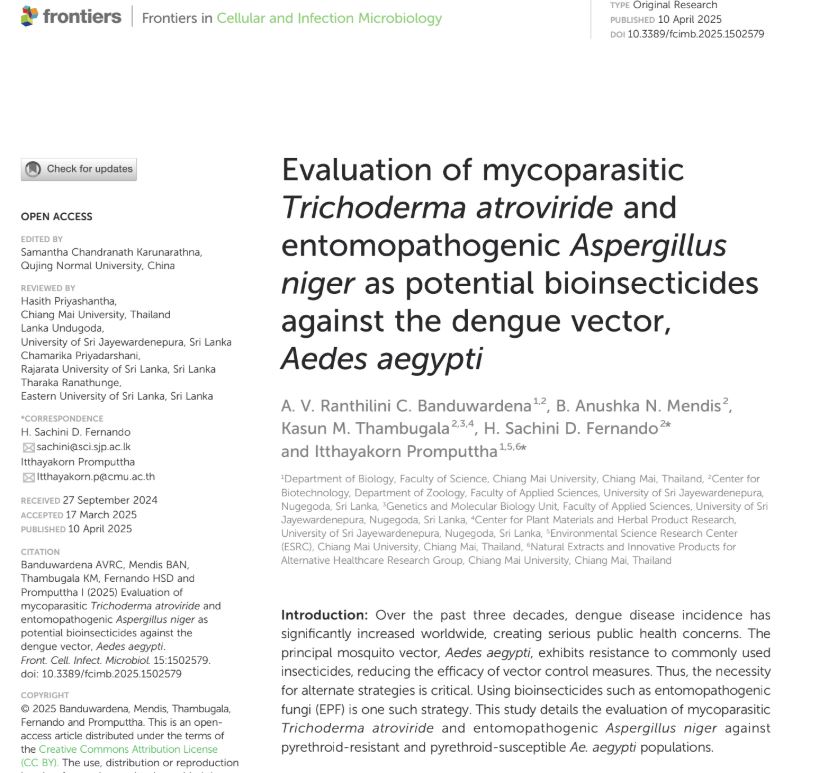
Evaluation of mycoparasitic Trichoderma atroviride and entomopathogenic Aspergillus niger as potential bioinsecticides against the dengue vector, Aedes aegypti

Published in: Frontiers in Cellular and Infection Microbiology

DOI: https://doi.org/10.3389/fcimb.2025.1502579

Introduction: Over the past three decades, dengue disease incidence has significantly increased worldwide, creating serious public health concerns. The principal mosquito vector, Aedes aegypti, exhibits resistance to commonly used insecticides, reducing the efficacy of vector control measures. Thus, the necessity for alternate strategies is critical. Using bioinsecticides such as entomopathogenic fungi (EPF) is one such strategy. This study details the evaluation of mycoparasitic Trichoderma atroviride and entomopathogenic Aspergillus niger against pyrethroid-resistant and pyrethroid-susceptible Ae. aegypti populations.

Materials and methods: Molecular identification of the isolated entomopathogenic fungal strains was done using ITS-rDNA sequence data. Larvicidal and adulticidal assays were performed using different spore concentrations of fungal species. Pupal emergence was assessed from the survived larvae of larvicidal assays.
Results: Larvicidal assays revealed the highest mortality of 60% for T. atroviride after 9 days of exposure when compared with the highest mortality of 52% for A. niger after 6 days of exposure. No significant difference was observed between the pyrethroid-resistant and pyrethroid-susceptible mosquito colonies, suggesting a lack of connection between prior resistance status and EPF pathogenicity. No pupal mortality was observed, although pupal duration was prolonged. Both EPF strains exhibited 100% mortality in adulticidal assays, signifying the potential use of the two fungal species as adulticides.

Conclusion: However, further studies are needed to understand the biology of EPF, its mechanism of action, the mosquito immune pathways activated, and the effect on non-target organisms. The findings have implications for the possible use of A. niger and T. atroviride as potential bioinsecticides against the control of Ae. aegypti.
Toxicity assessment of collagenfrom Decapterus macarellus: a zebrafish modelstudy

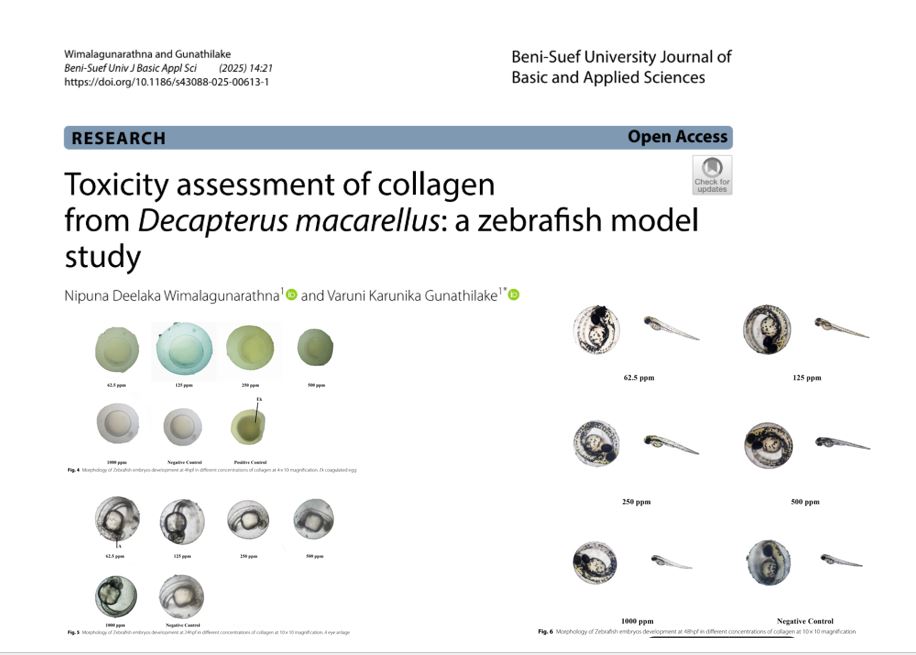
Collagen, derived from various biological sources, is crucial in supporting a range of physiological processes and developmental pathways. However, concerns have been raised regarding the potential teratogenic effects of collagen. The zebrafish (Danio rerio) model has emerged as a premier vertebrate model for investigating the impact of biomaterials on vertebrate development, both under normal and pathological conditions. The present study sought to assess the acute toxicity, developmental toxicity, cardiotoxicity, and teratogenic toxicity of fish collagen extracted from Decapterus macarellus fish species on various developmental parameters. Acid-solubilized collagen was extracted from D. macarellus, and zebrafish embryos (<96 h) were subsequently exposed to varying collagen concentrations of 62.5 parts per million (ppm), 125 ppm, 250 ppm, 500 ppm, and 1000 ppm. Key developmental parameters, including survival rate, hatching rate, heart rate, and deviations in four apical points: embryo coagulation, lack of somite formation, non-detachment of the tail, and lack of heartbeat observations were recorded over a period of 0–96 h post-fertilization (hpf ). Positive and negative controls were parallelly carried out analysing the results statistically with pairwise Kruskal–Wallis test followed by a Dunn pairwise test.

The results indicated that the survival rate of zebrafish embryos ranged from 96.97±5.25 to 82.28±9.80%
at 96 hpf across all tested collagen concentrations. No significant differences were observed (P>0.05) compared to the negative control group or between the various treated concentrations. The hatching rate at 48 hpf and heart rates at 72 hpf and 96 hpf in the treated groups showed no significant variations compared to the negative control (P>0.05). Furthermore, no abnormal changes were recorded in the four apical points; embryo coagulation, lack of somite formation, non-detachment of the tail, and lack of heartbeat in embryos, treated with collagen. All the observed results cumulatively indicated the nontoxic effect of collagen from D. macarellus on zebrafish embryo development.

The results confirm the extracted from D. macarellus is nontoxic and causes no teratogenic effects in zebrafish embryo development. It further validates the potential of using collagen as a biocompatible material, where non-toxicity and developmental safety are paramount.

Mapping the vegetation and spatial dynamics of Sinharaja tropical rainforest incorporating NASA’s GEDI spaceborne LiDAR data and multispectral satellite images

Published in: iForest

DOI: http://www.sisef.it/iforest/contents/?id=ifor4632-017

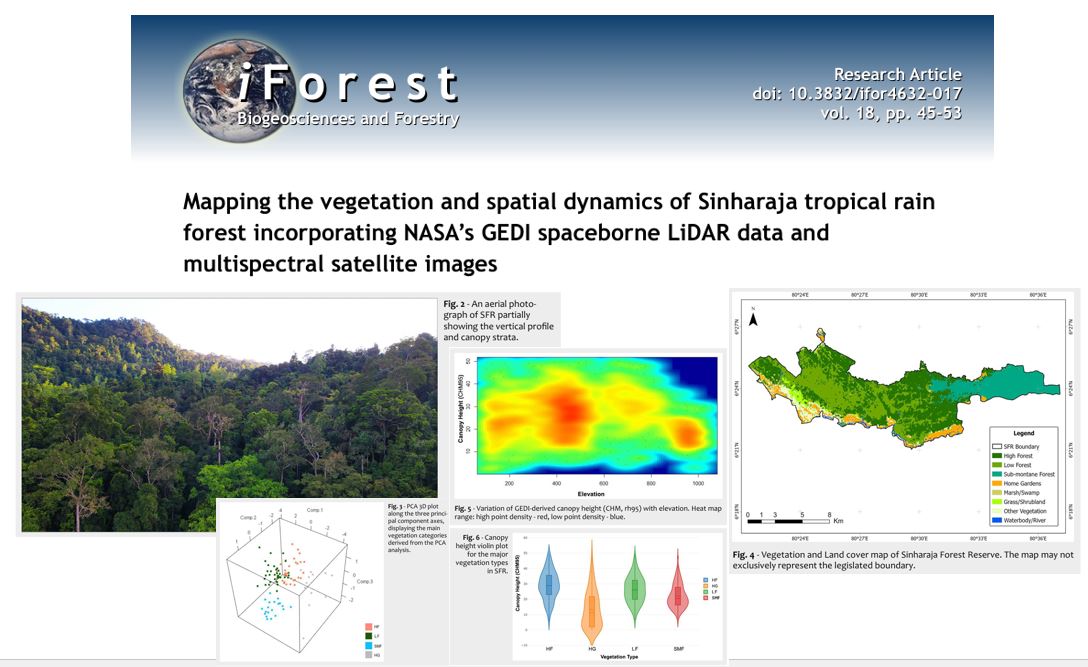
This study integrates NASA’s Global Ecosystem Dynamics Investigation (GEDI) spaceborne LiDAR data with multispectral satellite imagery to map the vegetation and assess spatial dynamics within the Sinharaja Forest Reserve (SFR), located in the southwestern Sri Lanka. Utilizing advanced remote sensing techniques, we delineated vegetation structure, vegetation density distribution, and canopy cover at high spatial resolutions. Eight distinct vegetation/land cover types were identified and an updated vegetation map was developed for SFR. The resulted map recorded an estimated overall accuracy of 90% (Kappa coefficient = 0.9) by the accuracy assessment. Comprehensive insights into forest composition and spatial dynamics were achieved with regard to canopy heights, plant area index and plant area volume density. Our results suggest that the integration of GEDI LiDAR and satellite imaging data offers a robust framework for characterizing tropical forest ecosystems, facilitating better understanding of their ecological processes, and informing conservation and management strategies.

Chemical composition and biofilm inhibition potential of selected biofouling organisms from coastal waters of western Sri Lanka

Published in: Regional Studies in Marine Science

DOI: https://doi.org/10.1016/j.rsma.2025.104120

There is limited knowledge of the physical and chemical properties of the biofouling organisms in the coastal waters surrounding Sri Lanka. This study investigates the chemical diversity and environmental resilience of nine species of marine macrofouling organisms through secondary metabolite-induced effects on biofilm formation. The anti-settlement assay revealed that Schizoporella errata, Botrylloides violaceus, Callyspongia diffusa, Halichondria panicea and Acanthella cavernosa showed significant resistance to Escherichia coli settlement and biofilm formation within the first 12 h (OD600 < 0.1). Following gas chromatographic and mass spectrometry (GC-MS) analysis, antimicrobial compounds such as dodecanoic acid, methyl palmitate, β-caryophyllene, hentriacontane geraniol and β-asarone were detected in these species.